Deathmatch Island
Deathmatch Island (or DMI) is a game that takes John Harper’s Paragon system, and makes it sing in a way that the original game (Agon) never could.
Hyperbolic? Probably! But give me a few moments to back that statement up.

Agon (the game that launched the Paragon system) is … well, it’s fine. The theme (built around Greek-coded heroes, possibly more relevant now that Nolan's take on The Odyssey has delivered a lot of butts into movie theater seats) never really clicked for me when I read through it, though I found the system interesting enough to compel me to grab a copy. I think that part of my issue was that I bounced off the theme so hard, not because it’s a BAD theme, but because I had a hard time internalizing how I could muster the enthusiasm to tell a story about bronze-age warriors doing bronze-age things.
Enter Deathmatch Island, written by Tim Denee and published by Evil Hat. When I first heard about it, the name initially scared me off; I grew up playing enough online shooters that I associate the word “deathmatch” with a certain level of player toxicity, and I’d assumed that some of this vibe would be ingrained in the game itself. I’ve done deathmatch culture, thanks; no need for me to revisit that theme, plenty of other excellent games for me to play, etc. And that was that, or so I thought.
But for the next few months, DMI kept popping up in RPG discussions all around me. Players and GMs who I trust started whispering that this game was, in fact, pretty dang good. I heard a little more about the game’s tonal touchstones – it's more aligned with Lost and Squid Game, less aligned with Doom the Movie – and started to get curious. Then I heard that it used the Paragon system, and that was enough to finally get me poking around for game details and reviews.
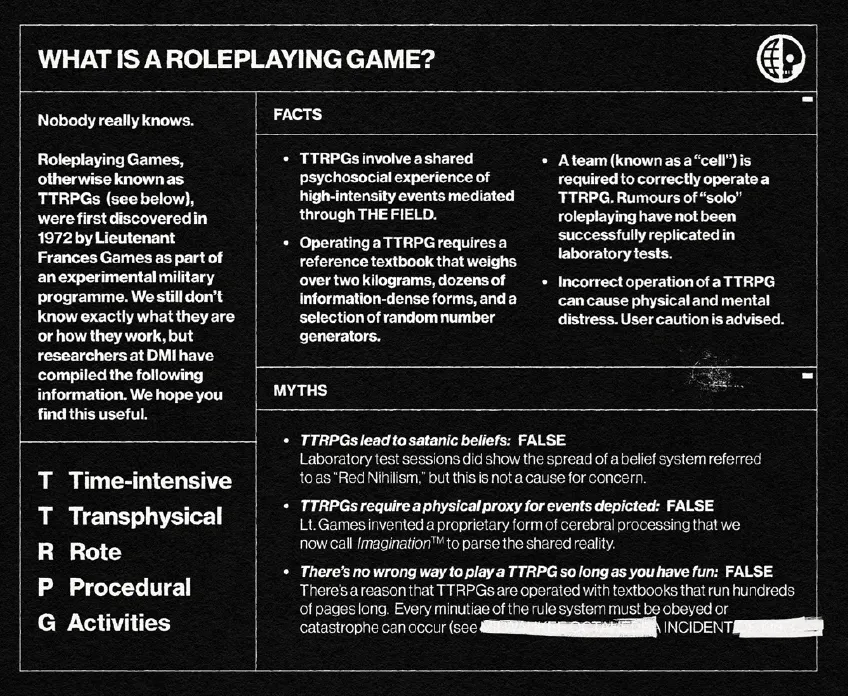
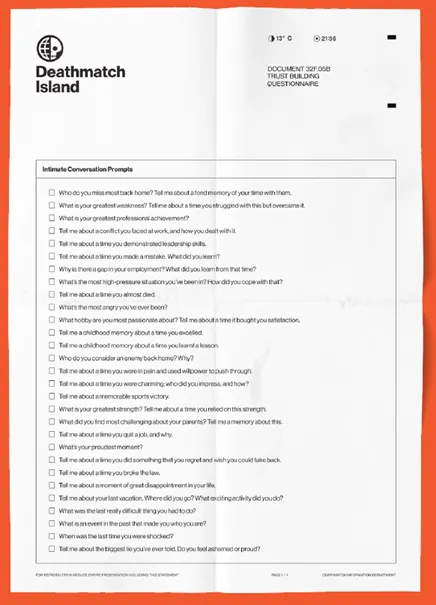
That’s when I started to see actual pages from the game itself. The clean, elegant layouts and pitch-perfect illustrations. The forms, sheets, and paperwork that practically ooze with deadpan corporate humor. The random character generator that will happily give your friend a Black Ops combat veteran while you end up piloting an Ice Cream Scooping Specialist.
In short: the vibes of the game are simply astounding. And for a group that’s willing to engage with the premise, and with their own characters’ motivations (for better and for worse), it delivers an unforgettable experience.
The Session
DMI can be run as a one-shot, although I don’t think that’s really the best way to experience it. In a longer-form game, the players will explore three islands in series. Each island has a Phase One (where the players explore locations on the map and engage with localized challenges and conflicts), a Phase Two (where the players scramble to gain advantages over other factions the group has met in Phase One), and a Phase Three (a culminating deathmatch contest with a pre-defined number of allowed survivors). And then there’s a little downtime you get between islands where you have the opportunity to learn more about each of the characters.
We planned for our one-shot session to run for three hours. We followed the game's guidance for running one-shots (and really, why don't more games provide guidance for this?): we built characters, ran a Phase One, did some small-scale character development, and went right into the End Game that you’d normally see at the end of the third island. This used all of our planned time and then some (we ran over by about an hour), and even though this skipped over a lot of what the game has to offer, it was enough of an introduction to make me very excited to try the game again.
The Good
Having gushed sufficiently on the game's vibes, I need to pivot to the game's core resolution/consequence system, which ... man. I didn't expect how much I would end up loving this.
The core gameplay loop involves setting up scenes where the group decides how they want to engage with the scene. The GM looks at the environment and opponents, assembles a dice pool, and the roll defines a “target number” for the scene. Most of the time, these numbers end up being somewhere in the 7-10 range, skewing higher for locations/situations with more danger.
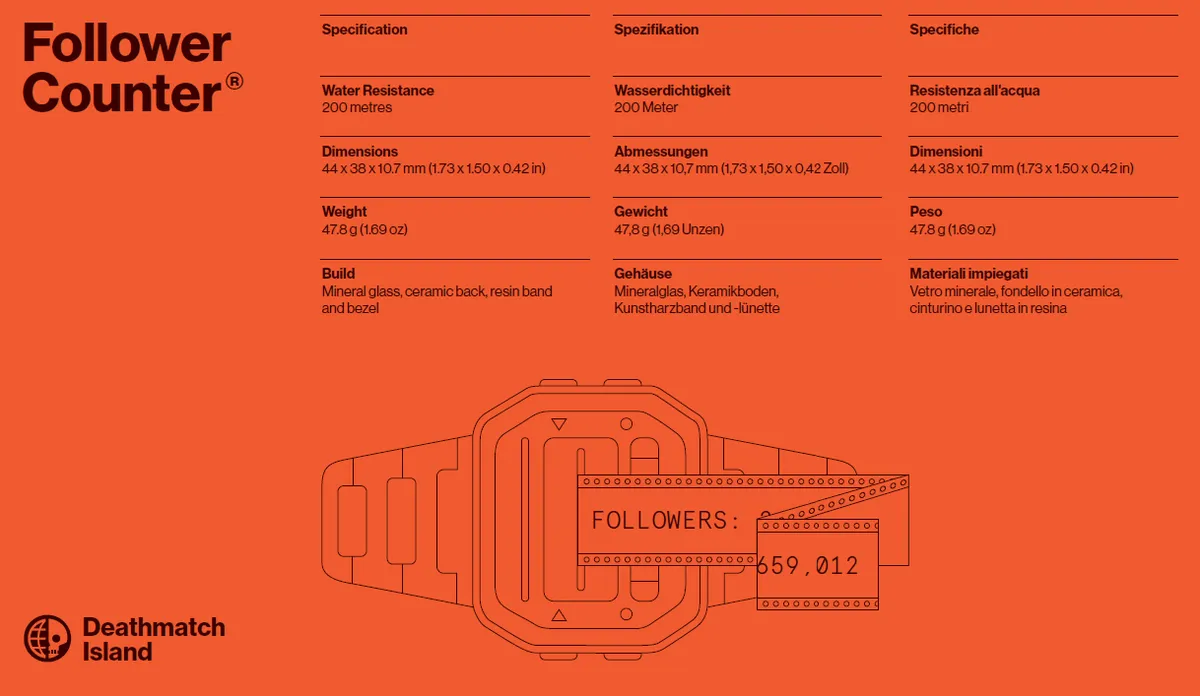
The players then assemble their own dice pools, based on the skills/experiences/gear they are bringing to the situation, and try to roll results that meet or exceed that target number. The math of the system – add your two highest dice, plus the highest single value of any d4 dice for equipment you’ve brought to the scene – works out such that players have good shots at hitting the target, but success is never a sure thing. Players that fail their test rolls suffer fatigue or injury, and players that succeed gain more new “followers”: an abstract count of the number of people watching the game who are invested in your character’s success. The player who rolls best gets an extra follower bonus, and can decide how to divvy up any rewards from the location.
But that’s not the exciting bit! The scene doesn’t actually play out until everyone has rolled, and then players take turns (starting with the player who rolled the lowest, and progressing through to the player who rolled the highest) explaining how their character engaged with the scene. Crucially: this is not done as standard present-tense action narration, but as post-action interview “testimonials.”
This part of DMI's gameplay really brings the unique premise of the game into sharp relief: your character is on a reality TV show, and this is the part where the editor splices in your character’s post-mortem thoughts on what happened in the scene. And since you don’t end the scene until the final player has gone, everyone whose narration happens earlier ends up naturally leaving space for the last players who haven't spoken yet, ultimately ending with the players who (hopefully) manage to prevail.
I genuinely can’t overstate how cool that aspect of the game was. It sold the reality television aspect of the game, and sold it hard. If there’s one thing that this game does uniquely well, it’s selling the context that your characters are not just engaging in conflict and challenge; they're doing it for the pleasure of people who are watching them suffer and die.
The Bad
While the game does offer explicit advice for running the game as a one-shot, I still felt like we didn’t have enough time to get through everything. Again: we went an hour over the planned time for our session, and I still felt rushed.
As it was, the group never really encountered the cast members on the island (as they don’t show up often in the restricted areas that the group wanted to explore the most). We never got to explore the cross-faction conflicts at all, and just scratched the surface on the relationships (good and bad) that were developing between the characters.
Looking back, I think that I would have done a few things differently – having all characters pre-generated before the session for sure, and possibly just trying to do a full one-island cycle instead of jumping right to the end game. The end game is very cool, and gives you a great ending point to your story, but getting there in a one-shot felt like we had to go TOO fast to make it work. Going through a full three-phase island might have given us a chance to experience some more of the things we had to skip.

Noteworthy
The players in our session all brought their A games. Everyone leaned into their hidden motivations, resulting in one character playing into the obvious-antihero archetype, and another doing an unexpected heel-turn near the end. The post-action interview scenes were consistently excellent. Everyone talked about the scene in the past tense, and gave the perspectives of their characters, who were not always reliable narrators. One player went so far as to set up a set of OBS camera overlays and lighting cues to differentiate normal gameplay, post-action interviews, and other situations. You simply couldn’t ask for a better group to kick the tires on a game.
It's worth pointing out that the interviews weren't just action recaps: they were full-fledged character development beats. The stories our players told built and reinforced their characters' worldviews. Some stories leaned into the "look, I'm not here to make friends" trope. And one harrowing late-game interview where one character -- having just been forced to kill a friend -- simply looked into the camera silently for a long moment, then said "fuck this place. Fuck this whole god damn place." Genuine shivers.
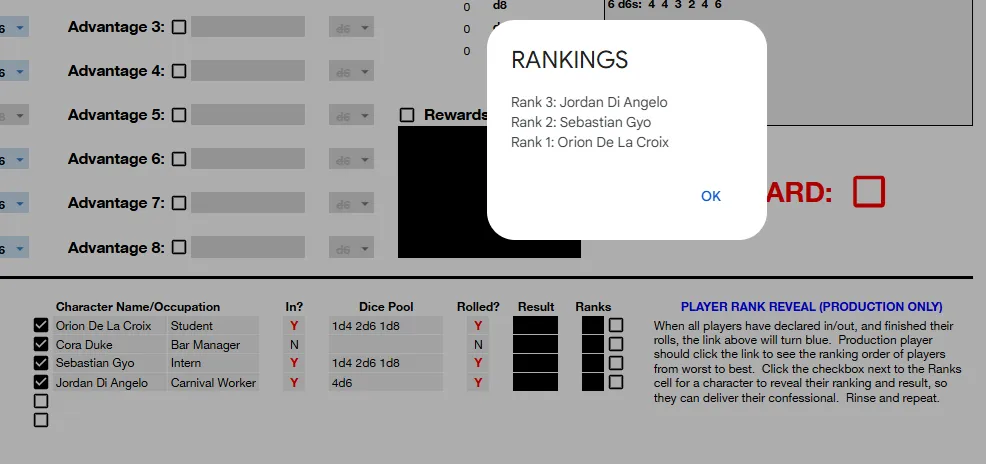
We used a Google Sheets VTT1 to help facilitate the session, and I think it worked well as a combination character keeper, dice roller, and GM notepad. One thing that I liked about that part of the experience is that the sheet was able to hide the results of player rolls in a scene – just letting the GM know the order of worst-result to best-result, and showing a player’s result to that player just before they started their narration. It added a bit of tension and uncertainty that I think helped sell the vibe of the game.
Overall? This is a very, very strong recommendation from me. DMI delivers a unique experience you and your players won't forget. This is a legitimate home run from Tim Denee, and I'm excited to play it again soon.
You can pick up a copy of the game from Evil Hat here.
Bonus Player Commentary
I had semi-intentionally avoided the game as Agon held no interest to me, but merely looking at the character sheet set up (including Gemelli’s spreadsheet magic), seeing the chatter pre-game, and the voice of the book itself made me drop my regular Sunday plans to join this game. I regret nothing, and have since run the game myself, planning to do so again. (alex v / @va.al)
Having run it once and played it once, I really like this game. The "Who’s Best?" question that the Paragon system chassis asks fits super well with the adversarial premise of a battle royale (maybe more than in Agon, where it was born). I think it does a very good job of making the players compete in-fiction, while at the same time the way results are narrated (and one player builds on the narration of another) makes the players collaborators in reality, and that is a very neat combo. Do agree with Gemelli that it probably needs more than one session to be fully realised (even though I think the recommendation of continuously replaying the game until Production is fully destroyed is also too much time investment). (Otávio / @xaitza)
I think Deathmatch Island really use the Paragon system in a super clever way. It works really great with the idea of a battle royale. I don’t think it works really well in a one shot though, which is really a bummer. One of my fears is that I feel the game could become quickly repetitive after the first run (or two?). I don’t know how a full campaign of it would feel. I’m not really into the kind of reality TV confessional stuff too, so I think I got a bit less into the game than I could have, but still a very fun one. Also the book for me is on a Triangle Agency meta level, maybe less gonzo but still suuuper good and I recommend everyone give it a read!! The system is a bit weird to explain but not difficult to understand and use, and I think people can create so many different games with it, it has a lot of super good potential. (adrian / @adrianhb)
DMI is great. The system is meticulously crafted to pit players against each other through a careful synchronization of narrative and mechanics. Character creation quickly creates personalities with the necessary crunch and nuance to dig into. The game's testimonial style roleplaying is unique, but the kind of artificiality that comes from post-facto testimonials can get in the way of emergent gameplay. I would recommend people try it for themselves. (Zadig / @zadig17)